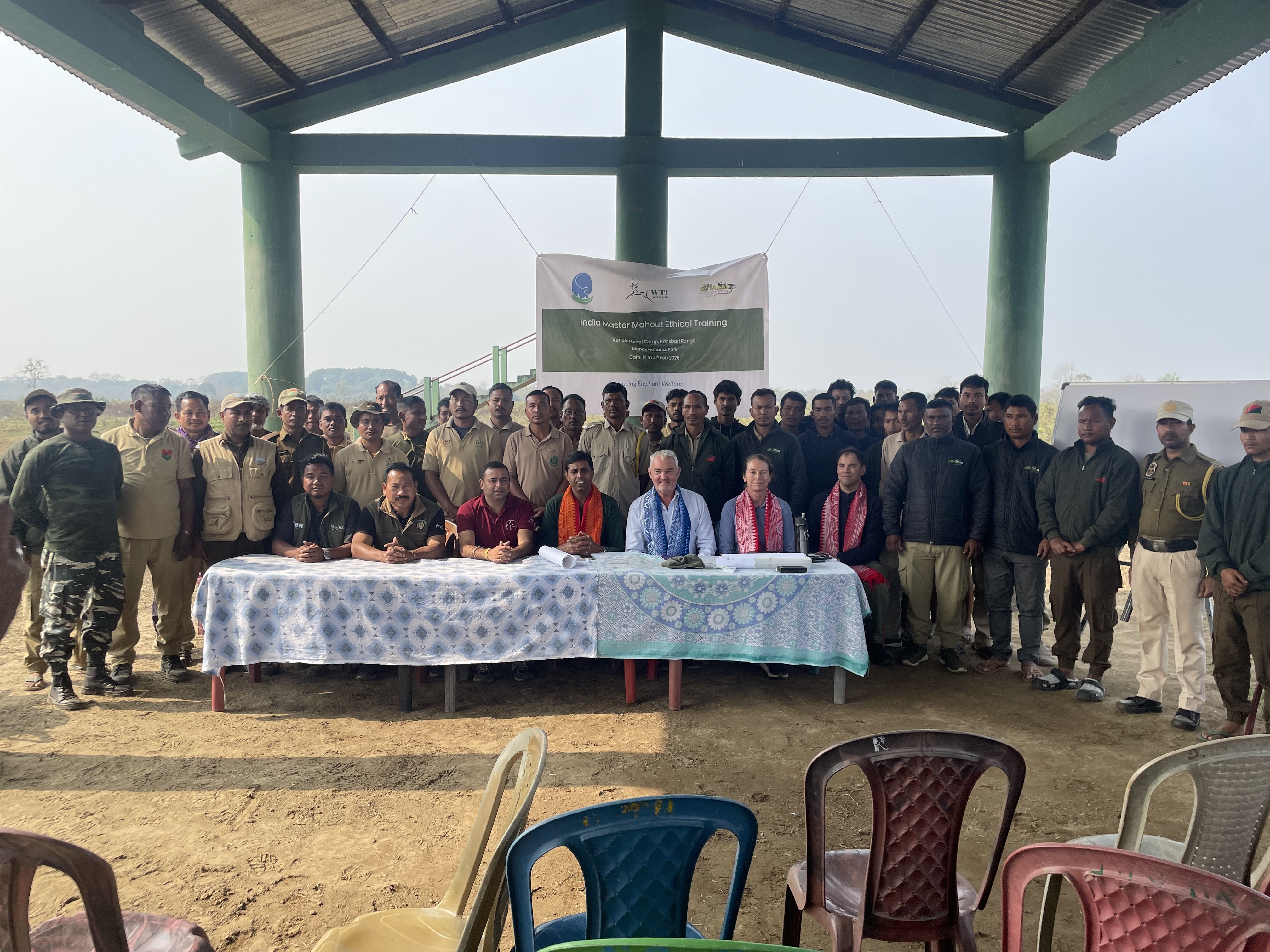
Click on the image below to view a video of H-ELP's 2026 Assam Training Camp
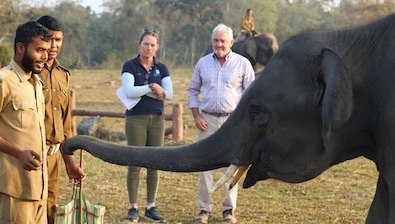
To weigh an elephant in the absence of large enough scales you use a formula that is both surprising and surprisingly accurate. First, you take a long rope and pass it around the circumference of the elephant’s chest. Then, you measure the rope, multiply the number of centimetres by 18 and from that number subtract 3336. That is the elephant’s approximate weight in kilograms which you will need in order to calculate doses of medication and to check that she is maintaining a healthy body condition.
However, before you can approach the elephant, before you pick up a rope or step within range of her trunk or her feet you must first check with her mahout. He knows her better than anyone and the two of them are rarely apart. He finds her forage, shade and water and, at the end of each day, he scrubs her large body in the river with a handful of grass. In turn, she knows the sound of his voice, his weight and the pressure of his heels on her neck.


This relationship, the one between a mahout and his elephant, is as many as 5000 years old. Although their tradition is ancient, mahouts are just like everyone else. Sometimes they talk on their phones or check their emails when they should be working. They have bills to pay, children to educate and family dinners to get to, just like the rest of us. Unlike us though, they work with an animal that weighs several tonnes and could easily kill them. And they have inherited a practice that comes from a time when human life was cheap, when you measured your wealth in slaves and when women were traded like livestock.
Elephants can live for 65 years which means that today’s mahouts may be working with animals originally trained in the 1960’s and 70’s. And while it isn’t true that elephants never forget, they do have extraordinary memories largely due to their extremely complex social interactions and the need to find large quantities of food in a landscape that is often affected by flood or drought. Our understanding of the rest of their cognition is less comprehensive though. Mahouts tell stories of abused elephants that have escaped their chains at night, entered a sleeping village to seek out the man who beat them and then kill him, often carefully stepping over sleeping family members on their way. Paradoxically, there are just as many stories of elephants gently picking up and carrying a trusted mahout home from the bar after he has a few too many drinks. Anecdotes like these are not science but they do show us that, when it comes to elephants there are still many mysteries we do not understand.


Right now, the Asian elephant is in a difficult position. A third of the population of this critically endangered mammal lives in captivity and climate change, habitat loss and conflicts with humans are set to drive that percentage way higher in the next two decades. If we want the children of our children to see living elephants (and not just computer generated ones), keeping them in captivity is an unavoidable reality. But here’s the problem; Asian elephants are mostly found in the developing world and they’re terribly, even cripplingly, expensive to keep as pets. Add to that, they need to forage and walk several kilometres per day, have meaningful social interactions with others of their kind and challenge their complex brains and sensory systems in a dynamic, natural environment in order to live their best lives.
Without massive funding, that lifestyle requires a mahout and being a mahout is a dangerous and low status job. In India most mahouts begin their careers with little or no elephant experience and even in a country where paid employment can be hard to get it’s difficult to recruit mahouts and even harder to keep them. The ancient tradition upon which their job is built did not prioritise the welfare of either the elephant or the man who lived alongside it. That there are not more serious injuries is a testament to both the elephant’s trainability and the mahout’s ingenuity.
It’s truly amazing what a skilled mahout and his elephant can do. In national parks they can silently track poachers and protect populations of wild elephants, tigers and rhino. They can take rangers or vets into places too inaccessible or dangerous to reach by vehicle. They can intervene in human conflicts with wild animals. They can help rescue injured wildlife. And they can do this without disturbing wild populations or burning fossil fuels while at the same time providing employment and, if trained and managed appropriately, living a meaningful and fulfilling life.
The Asian elephant will need an awful lot of people on her side if she is to survive beyond the twenty-first century. She will need vets, rangers, national park administrators, government officials, politicians, advocates and philanthropists but in almost all situations, to live a life that is worth living she will firstly need a skilled and well trained mahout.

The Help Foundation’s first training camp for 2026 was in Manas National Park in Assam, India. Manas was a fitting place to begin a big year of training because the park is a truly remarkable conservation success story and mahouts and elephants have been integral to the process. From the late 1980’s until the early 2000’s Manas was torn by civil unrest between Bodo insurgent groups and the Assamese government; a period of ethnic violence that led to many deaths and the displacement of thousands of people. Within the park, Bodo rebels attacked rangers and other park staff, poaching escalated and by the start of the 21st century there were no rhino and no tusker elephants left. Tigers were also targeted along with many other bush meat species such as deer and wild pigs.
After the Bodo peace accord was signed in 2003, Manas officials began rebuilding the park, protecting its vulnerable wildlife and restoring degraded grasslands and forests. Elephants and mahouts have been invaluable in this process as they can move silently through grassed areas and wetlands, taking anti-poaching rangers places where vehicles can’t reach. They provide an excellent vantage point for rangers as they are taller than even the tallest grasses and because of this they also provide protection from species such as tiger and gaur. In 2008 the first rhino were reintroduced and since then the numbers have grown to over 40 individuals. Elephants have been used extensively to manage the growing rhino population as they can take vets close enough for health checks and, as we would see, they can be used to move the rhino without stress.
Over the course of the four day training camp our work was to be disturbed several times by slow moving rhino cows with their calves meandering across the training field. Occasionally a mahout and his elephant would be sent out to quietly encourage them to move along but more often than not it was just an excellent opportunity to stop for some crackers and another small cup of extremely strong and sweet tea. On the third day of the camp a large male rhino came across the river and wandered quite close to the mahout accommodation where we were working. We were quickly mustered back to safety as this individual had taken to rolling the occasional safari jeep with apparent ease. The mahouts had named him after the Indian road traffic authority as they joked he was just checking the jeeps for up to date registration papers.
There is such a variety of wildlife in Manas now that we were always accompanied by a guard with a rifle, which is slightly disconcerting at first. Apparently the gun is loaded with blank shells – but there are live rounds in his pocket, just in case.

Our four master mahouts had been drawn from both Manas and Kaziranga National Parks. They were Kasim, Allum, Manuj and Ramanus, all very skilled and experienced mahouts. Three of them had already attended a Help training camp and it was amazing to see how much they remembered and how many of the concepts they utilised despite the camps being several years previous.
For four days we worked with two young elephants still with their mothers. In Assam it is not traditional to train young elephants until after weaning which means that young elephants can be more than five years old and 1500kgs before they learn basic commands. This can make them extremely difficult to treat if they become sick or get injured and it is dangerous for mahouts; imagine trying to give medicine to a one tonne toddler with a trunk! At the Help Foundation we believe it is not only ethical to train calves it also helps prevent the acquisition of incorrect habits and leads to better training outcomes in the future.

We spent the first two days making sure the young elephants (the mahouts called them babu, which means baby) were clear with step back (pichu) and step forward (agut). It was lovely to stand back and watch these skilled mahouts interact with the young elephants. Sabass means good in Assamese and you could soon hear them working with the youngsters, “Sabass, babu, sabass.” The mahouts were quick to adopt the five step positive reinforcement protocol that we advocate and soon the youngsters were reliably showing clear forward, backwards and stand still from voice commands alone.
There are also three orphaned baby elephants in the park and they share a mahout (or Mama mahout as the others refer to him) who spends all day with them. Everywhere he goes the babies go too, with the occasional foray to ransack the camp for anything edible. On the morning of the third day the babies decided to visit their friends and suddenly there were five young elephants on the training ground. Much excitement! Like children given a break from class. I will remember with joy the sight of Allum giving an impromptu training session in pichu to all three babies at once. “Sabass, sabass, sabass,” and his hands full of chopped banana.
For me, our master mahouts are like highly skilled tradesmen working with antiquated tools. When we show them other tools, like clear positive reinforcement protocols, it feels to me as though they have been waiting for them. I can remember when I had no knowledge of learning theory, I used to agonize over training situations wondering why they had failed; I knew there would be answers I just didn’t know how to find them. At this training camp I got that same sense from the mahouts. I felt like we provided answers for the real life situations that they encounter every day.

Over fifteen years ago The Help Foundation was founded to improve the welfare of working elephants in Asia. In that time the world has changed and our understanding of our task has become far more nuanced. Rather than teach practices, we now teach concepts. Rather than addressing large groups of mahouts, our goal now is to identify these key master mahouts and provide them with both an understanding of the principles that underpin learning and the teaching skills to pass their knowledge on to their younger peers.
The possibility of becoming a master mahout gives the young mahouts a clear career goal and incentivises welfare friendly training practices. Passing the responsibility for the training over to the local trainers is a more culturally appropriate goal and makes the mission of the Help Foundation more sustainable in the long term. We were lucky enough to spend time with a group of newly recruited mahouts and it was wonderful to see them model themselves on the master mahouts and also to see the respect that they had for the older men.
As we left Manas after our final day of training we felt as though we had achieved something really important, not just for The Help Foundation but for the future of the Asian elephant. And although you may never need to be able to estimate the weight of an elephant using just a rule and a piece of rope, it is highly likely that there are vets who will need to and their job will be made immeasurably easier and far, far safer by the presence of a mahout who has been supported to learn and who understands the principles of ethical and sustainable training.